
KMS Activator Tools Compared for Beginners
Several Windows and Office activation utilities are often discussed together: KMSPico, KMSAuto, Microsoft Toolkit and MAS. They are not identical. Some were built as simple one-click desktop apps, some offered more manual control, and newer projects moved toward script-based menus with several methods in one place.
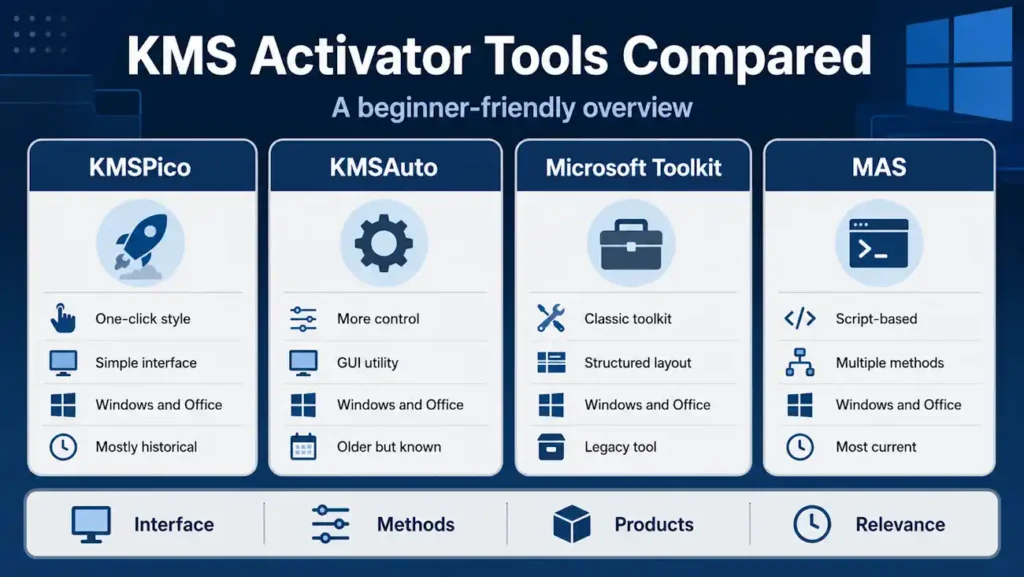
This guide does not show activation steps. It explains the difference in design, interface, age, methods and current relevance so a beginner can understand why these tools are not the same.
The basic idea
Traditional KMS is a Microsoft volume activation model used by organizations, a company runs an activation host inside its network, and licensed devices activate against that host.
Unofficial tools copied the general idea or built other methods around Windows and Office licensing behavior. That is why many names in this category include “KMS,” even when the newer tool may support more than one method.
Interface
The oldest style is the one-click desktop app. It usually hides technical detail and gives the user very few choices. This made it popular with beginners, but it also made the process harder to understand.
The second style is the configurable desktop utility. It still has a graphical interface, but it exposes more sections, buttons and product choices. This type is easier to study because the user can see separate areas for Windows, Office, status checks and settings.
The third style is the classic toolkit. It looks like older Windows administration software: tabs, status fields, product sections and action buttons. It was more organized than the one-click tools, but it clearly belongs to an older software era.
The newest style is the script menu. Instead of a polished app window, it normally shows numbered options and method names. It may look less friendly at first, but it is often easier for technical users to inspect, update and document.
Speed
Speed depends less on the name and more on the method, Windows edition, Office version and current system state.
A one-click utility feels fastest because the user does not choose much.
A configurable desktop tool may take longer because it has more options.
An older toolkit can feel slower because of its interface and extra checks.
A script menu can be quick after the user knows which option they are looking at.
For students, the useful point is this: “fast” does not always mean “simple internally.” It often only means the interface asks fewer questions.
Methods
Older utilities in this category are mostly associated with KMS-style behavior.
More recent script-based projects usually group several approaches under one menu. For example, MAS publicly describes methods such as HWID, Ohook, TSforge and Online KMS in its project materials.
So the real comparison is not only “old tool versus new tool.” It is also “single-method style versus multi-method menu.”
Supported products
Most tools in this category were made around Windows and Microsoft Office.
Older apps are commonly associated with Windows 7, Windows 8, Windows 10 and older Office releases.
Later tools are more often discussed around Windows 10, Windows 11 and newer Office or Microsoft 365 related scenarios.
The exact support depends on the specific version, not just the tool name. A very old build may not understand newer Windows releases, while a maintained project may add or remove support over time.
Developers and transparency
One important difference is how easy it is to identify the original source.
Old desktop tools are heavily mirrored. A beginner may find dozens of copies with the same name, different icons, different archives and unclear version numbers. That makes the history messy.
A public script project is easier to examine because updates, file changes and release notes can be visible in one place. It may not look as polished, but it is easier to compare versions and understand what changed.
For a student, transparency matters because it affects how easy the tool is to research.
Current relevance
The one-click activator era is mostly historical now. Those names are still searched because they became famous, but many pages discussing them are old, copied or unclear.
The configurable desktop utility era is also older, although the concept is still recognized.
The classic toolkit style is mainly useful for understanding how Windows and Office utilities looked in the Windows 7 and early Windows 10 period.
The script-based approach is the most current in public discussion because it is easier to update, document and adapt to newer Windows and Office builds.
Comparison table
| Category | Old one-click app | Configurable GUI tool | Classic toolkit | Script-based project |
|---|---|---|---|---|
| Interface | Very simple | More buttons and modes | Tabs and product panels | Text menu |
| User level | Beginner | Intermediate | Intermediate | Beginner to technical |
| Main style | Automatic | Adjustable | Organized utility | Multi-method menu |
| Product focus | Windows and Office | Windows and Office | Windows and Office | Windows and Office |
| Best for studying | Simplicity | KMS-style options | Legacy structure | Modern method split |
| Current status | Mostly historical | Older but known | Legacy | Most current |
Simple explanation
Think of these tools as four generations.
The first generation wanted everything to happen behind one button.
The second generation gave the user more control and more visible options.
The third generation organized Windows and Office actions into a classic utility layout.
The fourth generation moved toward scripts, public menus and multiple methods.
That is the difference a beginner needs to understand. They are often mentioned together, but they do not represent the same design, same period or same level of transparency.
Final thoughts
These utilities are usually grouped under one topic because they deal with Windows and Office activation, but the tools themselves are different.
The old one-click style is remembered for simplicity.
The configurable GUI style is remembered for more manual control.
The toolkit style is remembered for its older all-in-one layout.
The script style is more current because it is easier to update and document, for a beginner, the cleanest way to compare them is by interface, method, product support, age and transparency rather than by repeating the tool names in every paragraph.